




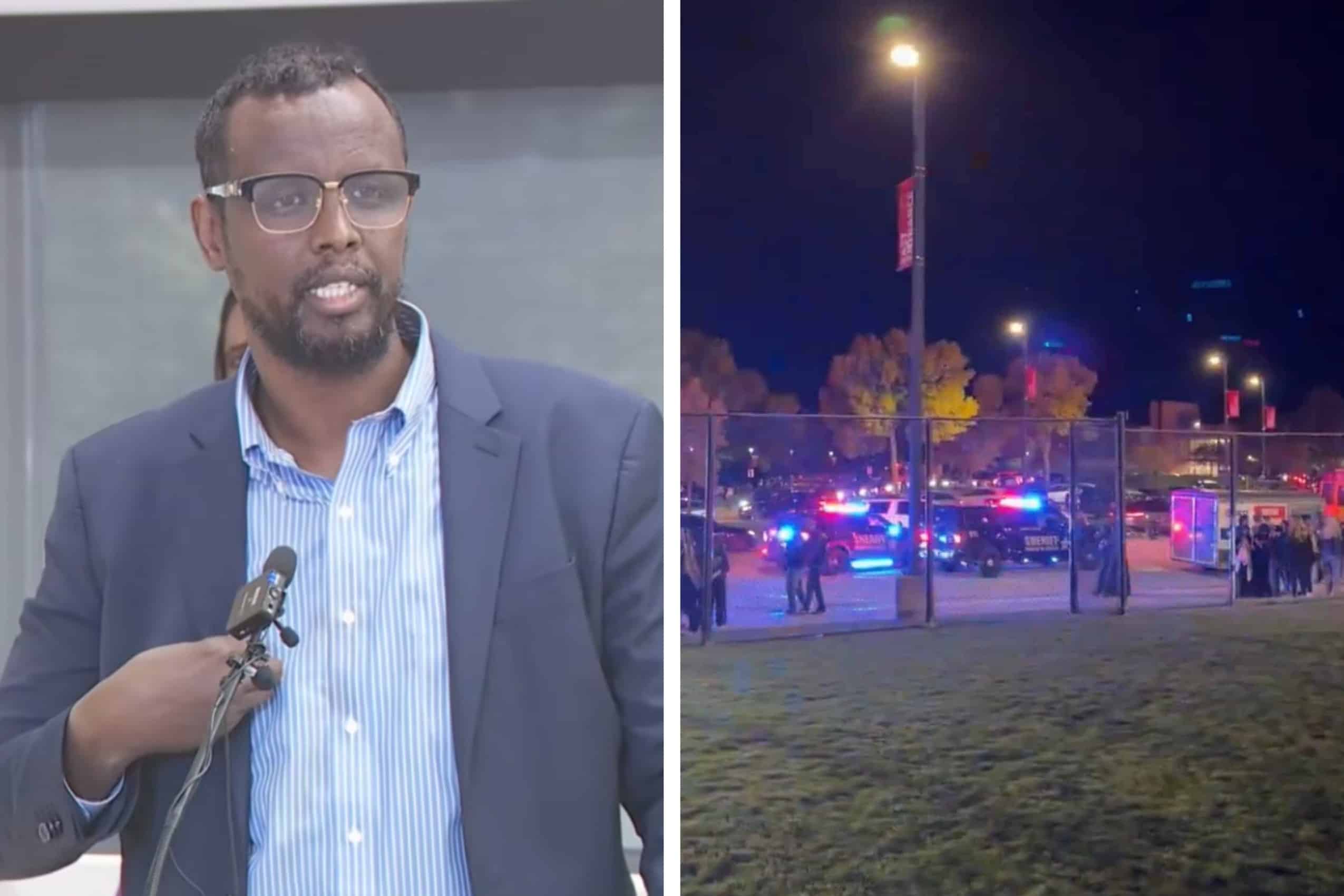
As Somali gang violence erupts across the Twin Cities, Somali community leaders gathered Wednesday to condemn the shootings — but also to push back against criticism of their community.
One blamed the gang members’ American upbringing. Another suggested Somali parents were working so hard they weren’t paying enough attention to their children. Others pointed to gun violence, media bias and politics.
The Oct. 7 press conference in Eden Prairie brought together Somali community leaders, parents and religious representatives following several days of gang-related shootings across the Twin Cities.
While speakers acknowledged that Somali youth were involved, several rejected the notion that the violence should be characterized as a Somali community problem.
Asad Aliweyd, an Eden Prairie resident and father of eight, acknowledged that Somali American youth were involved in the violence and said those responsible must be held accountable.
But when it came to explaining the violence, Aliweyd’s message was clear: These young men may be Somali, but they are also products of American society.
“We recognize that Somali American youth were involved, and those responsible must be held accountable,” Aliweyd said. “But those are also American youth, born and raised all here, educated here, and grew up in our communities.”
“This is not simply a Somali problem. It’s a youth violence and gun violence problem and we must address it together. The actions of a few should never define the entire community,” he continued.
Aliweyd is the executive director of a nonprofit that was ordered to pay back $1.1 million to the state for “fraudulent claims,” according to KARE 11. He has not been charged with any crime.
Islamic teachings weren’t supposed to lead to guns
Fardousa Yossuf, a Somali mother and teacher, expressed disbelief that children raised with Islamic values could become involved in gun violence.
“We never thought that our children, we have been raising them, and taking them to the Madrasa, which is to teach the Islamic values, that they will … get guns,” Yossuf said.
Yossuf offered another explanation for why some Somali youth are turning to gangs and guns: Their parents are working too hard to pay enough attention to them.
“We came to America … and so much expecting from us,” she said. “Sometimes I feel, in our community, we had too much, we worked very hard, and we really did not give enough attention to our kids.”
“I do believe that, because we’re always told we have to work hard, we have to do this,” she continued.
But Yossuf’s explanation that Somali parents are simply working too hard to keep tabs on their children comes alongside another striking reality: high rates of government assistance among Minnesota’s Somali immigrant households.
As Alpha News previously reported, a December 2025 report from the Center for Immigration Studies found that a staggering 89% of Somali immigrant households with children in Minnesota receive some form of welfare assistance. Even among Somali immigrant households overall, the figure was 81%.
“As a community, we must take the responsibility and we have to try our best to really do something about these things that’s happening,” Yossuf acknowledged, apologizing for what has happened.
Don’t call it a Somali problem; call it a gun problem
Farhio Khalif of Somali Youth Link also rejected the idea that the recent violence should be characterized as a Somali community issue.
“This is not a Somali community [issue] … This is a gun violence issue,” Khalif said.
She then took a detour through American gang history, seemingly suggesting the recent Somali gang violence is simply the latest chapter in a familiar American story.
“If you guys remember, it used to be an Italian gang, an Irish gang, and black gang, and now what a Somali gang?”
But Eden Prairie Mayor Ron Case brought the conversation back to the present and the gang violence unfolding in his own backyard.
“Yes, we’ve had many different waves of gangs come through in our nation’s history, but this, today, that we’re dealing with in our region, is definitely a young male Somali issue, and we need to come together to fix this so that it doesn’t broad brushstroke the 110,000 Somali community across the Twin Cities,” Case said.
Politics and the media get pulled into Somali gang violence debate
The discussion then shifted from gang violence to politics and media coverage.
Aliweyd blamed “the election” for what he described as increased hostility toward Somali Americans and biased news coverage.
“Because of the election, Somali communities are targeted to a lot of hateful messages [and] a lot of biased media,” he said.
He then took aim at the news media, arguing that crimes committed by Somali individuals receive different treatment than those committed by people of European ancestry.
“For example, there has been a shooting happened somewhere northeast of Twin Cities, and that person, they didn’t call that he’s a white, or German, or Irish, or from Norway or anywhere else,” Aliweyd said.
“But if a Somali person did something, it’s … the end of the world.”
And the reporters covering Wednesday’s press conference weren’t spared criticism, either.
Aliweyd told journalists it was their responsibility to report fairly and urged them to help “protect the [Somali] community, because we are immigrants who are new, we want to be part of the fabric of Minnesota.”
The press conference followed a string of shootings that have heightened concerns about Somali gang activity across the Twin Cities, with gunfire erupting outside a high school football game, on church grounds and in residential neighborhoods.
The violence has prompted residents to demand answers from city officials.

Jenna Gloeb
Jenna Gloeb is an Edward R. Murrow Award-winning journalist, media producer, public speaker, and screenwriter. Most recently, she worked as a reporter and on-air host for CCX Media. Jenna is a Minnesota native and resides in the Twin Cities with her husband, son, daughter, and two dogs.